Mika Mwape Chungwa
Mika Mwape Chungwa of the Nguni (Honeyguide) clan was born in Koni village, Chibale, in 1918. After the British redrew chiefdom boundaries in the 1920s, Koni fell within Shaibila’s territory. His grandparents hailed from the area around Kapiri Mposhi. As his mother had no milk, he was fed cow’s milk, a mixture of ground groundnuts and water (groundnut milk), and sweet water from sorghum stalks mixed with mealie meal. Subsequent children died on this diet. His father, an axe handler (shing’anga wa mupini) with great herbal knowledge, taught him the trade. His father was also an iron smelter (kengulula) and blacksmith. The colonial authorities halted smelting around 1930, fearing the potential use of the metal in manufacturing rifles and bullets. In 1935, he completed Standard VII at the Scottish Free Church boarding school in Chitambo, after which he left formal education.
In the 1930s, he knew the ing’omba Chitelela, Nkasabanya, and Susa personally, playing the ilimba or ciwaya in their ensembles.
In 1932, his uncle, the headman of Koni, dispatched him to the Bamucapi across the Congo border to procure medicine for cleansing Koni of disease and witchcraft. Following the arrival of prophets such as Mwepya Lesa, Lungo and Mwana Lesa in the 1920s, and the Bamucapi in the beginning of the early 1930s, all of whom promised to eradicate disease and particularly witchcraft, the ground was fertile for the Jehovah’s Witnesses’ message to take root. Mika Mwape Chungwa became a member and was imprisoned thrice for proselytising, which was forbidden at the time.
He subsequently travelled regularly to Kabwe and also to Bulawayo, where he worked as a shunter. In Southern Rhodesia (now Zimbabwe), he undertook training as a medical assistant. Following this, he worked in hospitals in Kabwe and Luanshya.
In 1951, he returned to Chibale chiefdom as the region’s first medical assistant, working at the new, small rural health centre in Chibale village. He served as a rural health assistant for three years, but it was very badly paid and when he resigned when a transfer was imminent. He opened a shop in 1955 and worked as a carpenter, primarily repairing writing desks for schools in Serenje District. Later, he established a sawyers’ cooperative to produce planks and similar materials for use in town. He was the first in Chibale to have corrugated iron roof sheets on his houses.
All these activities ceased when he fell ill in 1962. The illness persisted for three years. Despite seeking treatment at clinics and hospitals, his condition did not improve. He then consulted a shing’anga, banaMusana, in Masaninga, who successfully treated him him. She was the first person in Chibale to be possessed by a Mwami spirit. MukaMwami prophets had been well-known in Chibale during the first part of the twentieth century but no one in Chibale had previously been possessed by Mwami spirits. Towards the end of the third year of his illness, he experienced five episodes of apparent death. “Every time the spirits took my mweo [life spirit connected to the body] to the mpanga to show me herbs. They also taught me how to dance. They held me by my little finger and showed me how to use nsangwa and masamba and how to use my feet. After some time, they left me to dance alone while they clapped. Then they said: “Let’s take him back [to the village], otherwise they will think he has died and start preparing his burial.” After the fifth time, all my pains and illness were gone, and I asked somebody to bring me an offering (mumpamba) of 20 ngwee to perform the nightly Kubuka for him. After this, I became a (prominent) shing’anga.”
Photo 168 ∵ Mika Mwape Chungwa
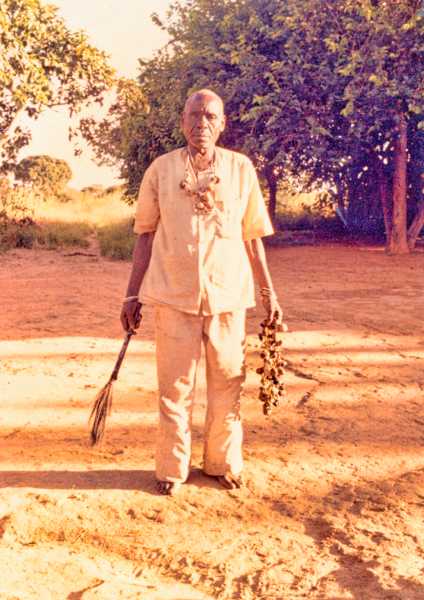 The shing’anga ba Mwela, Chibale village, 1986.
His medium name was Mwela (Wind, Spirit) because he was possessed by so many spirits of the Ciwila, Kaluwe, and Mwami types: ing’omba, chiefs, hunters, headmen, whites, imfunguni, and major spirits like Mulenga and Chipimpi.
He regularly worked in town as a shing’anga and not without success. Consequently, people from town also visited him in Chibale, for instance for barrenness (male or female), epilepsy, madness, leprosy, and elephantiasis. He treated people suffering from Mwami possession illness in Luapula and Northern Province, accompanied by a Lamba master drummer, presumably as the first to do so. He was also ill there and stayed in a hospital for a long period.
His position as a shing’anga among other shing’anga was comparable to that of an ing’omba among spirit-possessed individuals: a bit apart from it all and highly self-dependent. His peak as a shing’anga in Chibale was between 1965 and 1980. After that, he remained active in town up to 198,7 but in Chibale slowed down, which gave him the time to be truly involved in the research. Mika Mwape Chungwa wrote down his cases in a large book, including his dreams and the diagnoses made during Kubuka.
Photo 169 ∵ Mika Mwape Chungwa
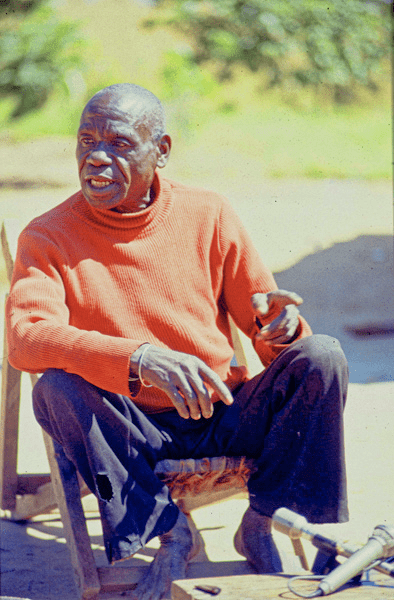 Mika Mwape Chungwa pointing out things, Chibale village, 1986.
In 1986, his spirits announced to him that they would stop performing Kubuka. In October 1987, he and his wife divorced. He had been married with her since 1957 and they had nine children. She had also been his helper in singing (kampenga). He could not live with the divorce. Two days later, his spirits left him, telling him to return to the Jehovah’s Witnesses [after 22 years]. He went to their church, took off his shirt, said, “I have returned”, and sat there. They received him with open arms. Two days later, he died.