Gatherings with music in Zambia: work
Gatherings with music in Zambia: work. Work songs can be sung for all kinds of activities, but most often during tree-cutting, pounding, and grinding.
The repertoire consists of any song the singers might like at the moment, plus a set of songs said to be proper work songs, for instance, pounding or grinding songs. This set, however, seems to consist mainly of songs from the mourning repertoires. The singer calls in the spirits of the deceased for help and shows respect by mourning with a view to a continuation of ishuko or to avert ishamo. Possibly, these mourning songs came to be considered as proper working songs because they only ‘survived’ as working songs.
Song 154
A song sung during the cutting of trees by men as remembered by banaNshimbi and her sister, 1987.

Text of Song 154 ∵ Counting the leopard’s spots is my story
(Yo) kali mwaice koya kwipaye mbalali owe eyaya
Palya pakupenda amambalashi e shitoli bata banshilile /
Palya pakupenda amambalashi teyalile bata bacolobola
(Yo) if I were young I would go and kill a leopard, owe eyaya
Counting its spots is the story in which my father left me /
Counting its spots is the same (story), my father, the great hunter
The singer mourns the loss of the father. Without him, the work is too much, like counting the spots of a leopard.
Song 155
A pounding song sung while pounding by Miliam Chisenga and Musonda Lubeni, 1981.
Text of Song 155 ∵ Come and help me
Mwebalele mu culu, nailila bamune yo
Seni muncishe mwebalele mu culu
Palikwikala bama, nailila bamune yo
Patalala pali kwikale nshimbi
Iya iya iya iya iya iya
Bamupanda nsengo nailila bamune yo
Emwe mukolengela abanenu ukulila yo
Iya iya iya iya iya iya
You, who are lying in the anthill, I am crying for myself, oh friends
Come and help me, you who are lying in the anthill
Where my mother stayed/lived, I am crying for myself, oh friends
It is all quiet where the steel [mother] once lived
Iya iya iya iya iya iya
Those who bewitch using horns, I am crying for myself, oh friends
It is you who cause our people to cry/mourn
Iya iya iya iya iya iya
In the first stanza, the dead relatives are called for help. In the second, the mother is mourned, and in the third, the causers of mourning are denounced. Though the first bringer of the song was not remembered, it is very likely that the song consists of three verses in one musango, brought as separate songs by a medium in the past.
As in many women’s songs, there is also critical commentary on the husband (not in the recording).
Spoken while pounding:
Tubatwiletwile We pound and pound for them
Balya batapela Those who do not give
Bacileya mwiko Those who never fail to see a cooking stick
Tubatwile twile We pound and pound for them
Kucitwi ca mushi At the head (far end) of the village
Mwaba Lubeni At Lubeni’s [former farm of the singer]
Mutali kunema Everything runs smooth
Mutali kunema Everything runs smooth
Ba Manti Manti Manti Manti [husband of singer]
Iya iya iya iya iya iya
Kashila kaku Kabwe The road to Kabwe
Inya kuli ba Flenshi Yes, where Flenshi is
Inya endume yesu Yes, our brother
Inya twalikutwa kale Yes, we used to pound together
Inya citwi camushi Yes, at the head of the village
Inya kwaba Lubeni Yes, at Lubeni’s
Inya kako Yes, that’s it
Inya tubatwiletwile Yes, we pound and pound for them
Inya banaMutolwa Yes, banaMutolwa [fellow pounder]
Inya cileya mwiko Yes, who never fail to see a cooking stick
Inya bamunshipela Yes, who do not give
Inya tubatwiletwile Yes, we pound and pound for them
Gatherings with music in Zambia: work. More examples of pounding songs are presented in the article on women’s songs and dances.
Proverb 125
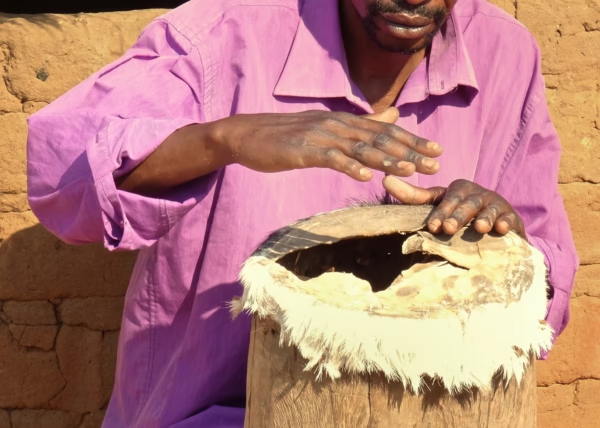
Umupama pamo watibwile ingoma
Hitting the drum at one place only will make it break
Concentrate on achieving a few things, not on many.
Breaking the drum is a positive image of perseverance. Working on one thing for a long time will eventually yield results, whether good or bad.
For a fuller explanation, see proverb 125 in the book Mu Zambia Amano Mambulwa.