Chibale Zambia: rules of life in an expanding world
Chibale Zambia: rules of life. Jehovah’s Witnesses and the spirit-possessed form opposites in the cultural landscape of Chibale. The rules they follow differ, but they share the belief that following rules of life is necessary.
Rules of life for the local and possession cults
The local cults and the possession cults distinguish three kinds of rules of life (mushila).
- Mishila ya mankowesha, the paths of [preventing] staining. Rules that regulate the contacts between human beings and the area and the spirit-world. Also called mishila ya kutina mpanga: paths of fearing the mpanga.
- Mishila ya mucinshi, the paths of respect. Rules to regulate the contacts between human beings among themselves. Also called mishila ya kutina bantu: paths of fearing people.
- Mishila ya kupola, the paths of cooling. Rules for solving problems, for instance healing a disease or solving adversity. Also called mishila ya kucitila: the paths of doing (solving/healing).
Kusunga/kutonda/kutina mishila: to follow rules of life. Kusunga: to take care of; kutonda: to respect; kutina: to fear.
Photo 59 ∵ Respect among mediums
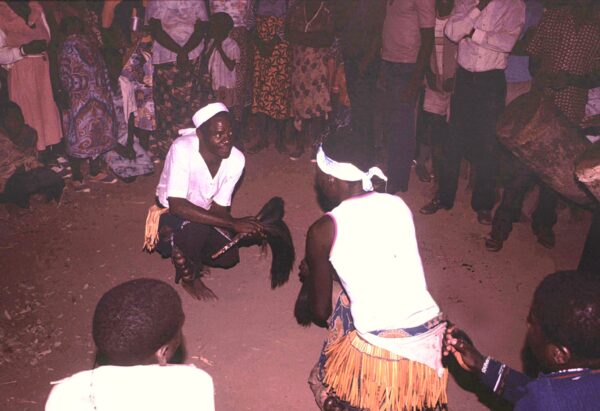 In general, mediums follow more life rules (mushila) than other people. Here, two mediums exchange a respectful greeting at an Ipupo.
Rules of life in christian cults
Chibale Zambia: rules of life. The Jehovah’s Witnesses are called baCitawala (those of the Tower) and baMboni (Witnesses). They have and seek a separate position relative to the rest of the population. They have a different lifestyle, and restrictions are imposed on their behaviour. For instance, no eating of meat from suffocated animals, no drinking or smoking (in public), no dancing or singing, apart from hymns., no polygyny, and no cross-cousin marriages. They also avoid contact with the spirit-possessed, especially when they are in a state of possession. Additionally, the aim is to change the contact between husband and wife and the ways problems are handled and solved. The Watch Tower Society provides its followers with a set of rules based on a thorough knowledge of certain parts of the bible, ‘God’s plan’.
These rules were introduced at a time when the continuous change in the rules of life (mushila) was outpaced by social developments. Viewed through the eyes of the people in Chibale, these rules of life were reshaped by the Watch Tower Society into a clear set. The quality of individuals’ lives was seen as a reflection of the quality of the life they would lead in the coming Kingdom of God. According to ex-Witnesses, the Society was less strict in the beginning (around the 1940s). “The increasing of strictness came with the decreasing of thinking (mano).”
Transformation of behaviour
The UCZ and the Roman Catholic Church also impose some of the mentioned rules, but they are less effective and determined in transforming their members’ behaviour. This contrasts with the possession cult groups in the 1980s. Membership in these groups was gained only after a thorough transformation of behaviour. The rationale behind this transformation was not to beget salvation by following God’s plan, but to reach and maintain mutual understanding (kumfwana) with the possessing spirit and benefit from its positive effects. The members of the possession cult groups follow rules of life of all three types. They are partly prescribed by the cult leader/healer and partly by each possessing spirit for the individual it possesses.
Similarities and differences
Chibale Zambia: rules of life. It may be tempting to represent the differences between Jehovah’s Witnesses and other people in Chibale to be as large as possible because the former were much more influenced by exogenous (North Atlantic) forces. Following this route, the choice of an individual in Chibale to become a Witness might be reduced to motives based on non-local reasoning. For instance, that in the pre-colonial period, it represented a desire for ‘total innovation’1Van Binsbergen: http://www.shikanda.net/ethnicity/labour.htm..
In the beginning, it certainly represented a, quite generally felt, desire for ‘instant salvation’. This is exemplified by the hope invested by the people in the prophets who visited the area in the mid-1920s: Mwepya Lesa, Lungo and Mwana Lesa, and in the beginning of the 1930s, the baMucapi. These were men who claimed that they could solve the problems of the time within a short period. The history of Mwana Lesa is well-documented2For instance Ranger (1975b), Verbeek (1983: 37-108), and Verbeek (1992: 89-102). The latter includes three songs, one of which goes as follows: Lwakwe lwakwe lwakwe umwine Teti akasambe lwapela mu matwi – It is the case, the case, the case of the one Who does not bathe above the ears. Mwana Lesa used as a witch’s ordeal the submersion of people in water to see whether they floated (witch) or sank (human)..
Two examples
Let us look at two issues that illustrate that the Witnesses were not completely different, for instance, because of feeding upon a superior, exogenous source.
Seur (1992: 402) notes: “According to the younger generation of Witnesses, many brothers and sisters had, in the past, given too much time and attention to secular work. In their quest for tangible assets they had wittingly or unwittingly neglected their religious duties and had spent too little time building up their family spiritually.” Of course, there is no exactly analogous quotation, but a shing’anga could have said: “Many people in their struggle with modern life neglect the rules of life (mushila) and have no time or energy to pay respect to certain spirits (kupupa). This brings them all kinds of problems that could have been avoided by following a purer lifestyle with more respect for what needs to be respected.”
And Seur (1992: 409) notes: “Some Witnesses of the ‘inner circle’ went so far as to state that the devotion of some Witnesses to their worldly activities, their single-minded pursuit of economic status through agricultural production, poses a serious threat to the spiritual well-being and thus to the survival of the congregation.” The parallel with witchcraft (accusations) is difficult to overlook.
Footnotes
- 1Van Binsbergen: http://www.shikanda.net/ethnicity/labour.htm. ↩︎
- 2For instance Ranger (1975b), Verbeek (1983: 37-108), and Verbeek (1992: 89-102). The latter includes three songs, one of which goes as follows: Lwakwe lwakwe lwakwe umwine Teti akasambe lwapela mu matwi – It is the case, the case, the case of the one Who does not bathe above the ears. Mwana Lesa used as a witch’s ordeal the submersion of people in water to see whether they floated (witch) or sank (human). ↩︎