Chibale Zambia: rules of life in an expanding world
Chibale Zambia: rules of life. Within Chibale’s cultural landscape, Jehovah’s Witnesses and the spirit-possessed stand as opposites. While their specific rules diverge, both groups share the conviction that adhering to a prescribed way of life is essential.
Rules of life for the local and possession cults
The local cults and the possession cults distinguish three kinds of rules of life (mushila).
- Mishila ya mankowesha, the paths of [preventing] staining. Rules that regulate contact between human beings, and the area and spirit-world (mpanga). Also called mishila ya kutina mpanga: paths of fearing the mpanga.
- Mishila ya mucinshi, the paths of respect. Rules that regulate contact between human beings. Also called mishila ya kutina bantu: paths of fearing people.
- Mishila ya kupola, the paths of cooling. Rules for solving problems, for instance healing a disease or overcoming adversity. Also called mishila ya kucitila: the paths of doing (solving/healing).
Kusunga/kutonda/kutina mishila: to follow rules of life. Kusunga: to take care of; kutonda: to respect; kutina: to fear.
Photo 59 ∵ Respect among mediums
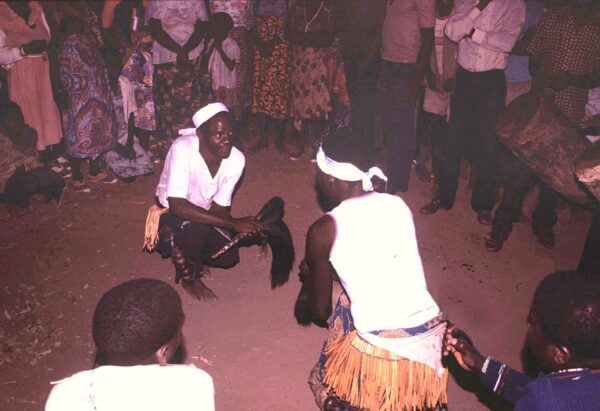 In general, mediums follow more life rules (mushila) than other people. Here, two mediums exchange a respectful greeting at an Ipupo.
Rules of life in christian cults
Chibale Zambia: rules of life. The Jehovah’s Witnesses are called baCitawala (those of the Tower) and baMboni (Witnesses). They maintain and seek a separate position from the rest of the population. They adopt a distinct lifestyle, with restrictions imposed on their behaviour. For instance, they are prohibited from eating meat from suffocated animals, drinking or smoking (in public), dancing or singing (except for hymns), practising polygyny, and engaging in cross-cousin marriages. They also avoid contact with the spirit-possessed, particularly when in a state of possession. Additionally, they aim to redefine the relationship between husband and wife and the methods for handling and solving problems. The Watch Tower Society provides its followers with a set of rules based on a thorough knowledge of specific biblical passages, which it interprets as ‘God’s plan’.
These rules were introduced at a time when the continuous evolution of life’s rules (mushila) was being outpaced by social developments. From the perspective of the people in Chibale, the Watch Tower Society reshaped these traditional rules into a clear set. The quality of individuals’ lives was seen as a reflection of the quality of the life they anticipated in the coming Kingdom of God. According to ex-Witnesses, the Society was less strict in the beginning (around the 1940s). As one put it, “The increasing of strictness came with the decreasing of thinking (mano).”
Transformation of behaviour
Similarities and differences
Chibale Zambia: rules of life. It may be tempting to exaggerate the differences between Jehovah’s Witnesses and other people in Chibale, as the former were much more influenced by exogenous (North Atlantic) forces. Following this approach, an individual’s choice in Chibale to become a Witness might be reduced to motives based on non-local reasoning. For instance, it has been suggested that, in the pre-colonial period, it represented a desire for ‘total innovation’1Van Binsbergen: http://www.shikanda.net/ethnicity/labour.htm..
Initially, it certainly represented a quite generally felt desire for ‘instant salvation’. This is exemplified by the hope people invested in the prophets who visited the area: Mwepya Lesa, Lungo and Mwana Lesa in the mid-1920s, and the baMucapi in the early 1930s. These were men who claimed they could solve the problems of the time swiftly. The history of Mwana Lesa is well-documented2For instance Ranger (1975b), Verbeek (1983: 37-108), and Verbeek (1992: 89-102). The latter includes three songs, one of which goes as follows: Lwakwe lwakwe lwakwe umwine Teti akasambe lwapela mu matwi – It is the case, the case, the case of the one Who does not bathe above the ears. Mwana Lesa used the submersion of people in water as a witch’s ordeal to determine whether they floated (witch) or sank (human)..
Two examples
Let us examine two issues that illustrate the Witnesses were not entirely different, for instance, because they fed on a superior, exogenous source.Let us examine two issues that illustrate the Witnesses were not entirely different, for instance, because they fed on a superior, exogenous source.
Seur (1992: 402) notes: “According to the younger generation of Witnesses, many brothers and sisters had, in the past, given too much time and attention to secular work. In their quest for tangible assets they had wittingly or unwittingly neglected their religious duties and had spent too little time building up their family spiritually.” Of course, there is no exactly analogous quotation, but a shing’anga could have said: “Many people in their struggle with modern life neglect the rules of life (mushila) and have no time or energy to pay respect to certain spirits (kupupa). This brings them all kinds of problems that could have been avoided by following a purer lifestyle with more respect for what needs to be respected.”
And Seur (1992: 409) notes: “Some Witnesses of the ‘inner circle’ went so far as to state that the devotion of some Witnesses to their worldly activities, their single-minded pursuit of economic status through agricultural production, poses a serious threat to the spiritual well-being and thus to the survival of the congregation.” The parallel with witchcraft (accusations) is difficult to overlook.
Footnotes
- 1Van Binsbergen: http://www.shikanda.net/ethnicity/labour.htm. ↩︎
- 2For instance Ranger (1975b), Verbeek (1983: 37-108), and Verbeek (1992: 89-102). The latter includes three songs, one of which goes as follows: Lwakwe lwakwe lwakwe umwine Teti akasambe lwapela mu matwi – It is the case, the case, the case of the one Who does not bathe above the ears. Mwana Lesa used the submersion of people in water as a witch’s ordeal to determine whether they floated (witch) or sank (human). ↩︎