Evaluation of music in Zambia: sustaining tone
Evaluation of music in Zambia: sustaining tone. In a song performed in public, and to a lesser extent in private performance, the singers sustain the last tone of the chorus line. They merge the last syllable of the text with e (pronounce: ay), or, rarely, o or a, or append e to it. This sound is then sustained, mostly in parallel fourths, for a while, maximally until the solo line starts again.
Photo 255 ∵ Kuwela
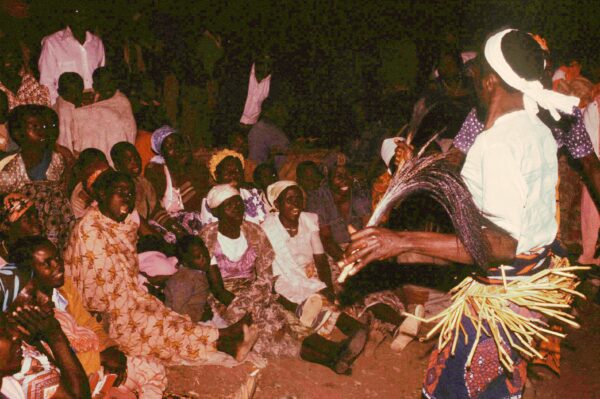 Kansenkele dances in front of a chorus of critical women. He has already convinced those with open mouths in the photo: they are doing kuwela. Others wait until Kansenkele has enticed them to do kuwela as well.
A good chorus sings loud and clear and sustains the last tone of the chorus line loudly for a long time (kuwela).
Salati Mukoti ∵ personal communication, 1981.
Music example 45
Kuwela by the chorus at a Cibombe organised by Chalebaila in 1981.
Evaluation of music in Zambia: sustaining tone. Not sustaining the last tone is called kuputula, to break off, one of the forms of incorrect performance (cileya).1However, when the solo-singer shortens a longer solo line, also called kuputula, it is pa kukafye cila, presumably because it suggests that the solo-singer will soon start dancing or that the solo-singer is singing while dancing.
Kuwela is important. Therefore, it is also used more generally for good singing by the chorus at larger-scale gatherings. Another meaning of kuwela is: cry, grieve, just like the other important word for ‘producing musical sound’, kulila: cry, mourn. The relation between music and mourning is pervading.
Footnotes
- 1However, when the solo-singer shortens a longer solo line, also called kuputula, it is pa kukafye cila, presumably because it suggests that the solo-singer will soon start dancing or that the solo-singer is singing while dancing. ↩︎