List 46: Sex, age and type(s) of possession of 154 spirit-possessed
List 46: Sex, age and possession type(s) of 154 spirit-possessed individuals.
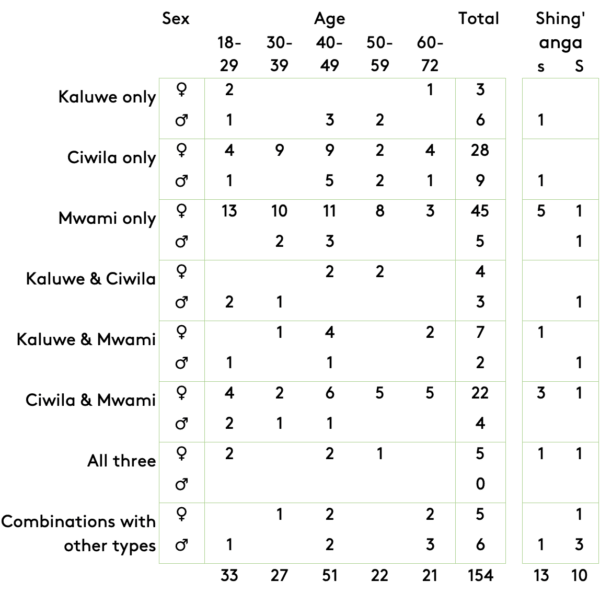
The list is based on the two surveys and other data collected from 1985 to 1987.
On the right-hand side, it is indicated how many persons from the various groups were small (s) or big (S) shing’anga.
Possession type: Mwami and Ciwila were more frequently found than Kaluwe possession. Taking together the frequencies of each type alone and of its combinations with other types, we arrive at an approximate ratio of 6:5:2 for Mwami:Ciwila:Kaluwe in the 1980s. The other types are Moba (8), Bayambo (2), and Imfunguni (1).
Sex: Of the people who were ‘fallen upon’, 77% were women. It should be noted that those who could not adapt to their possession were mostly women. Based also on other counts made in the 1980s, it could be generalised that the ratio of women to men for all spirit-possessed (mediums and patients) was 3:1, while for mediums alone it was 2:1. In Mwami possession and combinations of Mwami with other types, the predominance of women was greatest, with a ratio of women to men of 5:1. In Kaluwe possession and combinations of Kaluwe with other types, it was smallest, with ratios of 1:2 and 3:2 respectively. Kaluwe-possessed were often hunters (men) themselves.
Age: The average age of the spirit-possessed was 42.1 years, with a mode of 43.4. Differences between the average ages of women and men were fractional. Only male Kaluwe-possessed individuals, possibly combined with other types, were significantly younger, averaging 31.5 years, again because many Kaluwe-possessed were hunters. There was also some difference in average age between those possessed by one type only and those possessed by more types. This can be explained by the fact that possession often begins with the arrival of one or two spirits of one type, while other spirits, possibly of different types, may ‘join in’ later.
Shing’anga: The bigger shing’anga1Anyone who was able to heal or to solve problems was called a shing’anga. Thus, the herbalist who could treat some minor illnesses, and the diviner, who diagnosed minor problems, were also called shing’anga as was the exceptional person who was able to cure madness or other serious illnesses and problems. When comparing them, the former shing’anga were called ‘small’ or ‘minor’ (munini), the latter ‘big’ (mukalamba). A few of the latter were so prominent that they were also called ‘big’ even when not comparing them with others. Except when stated explicitly, on this website we use the word shing’anga to refer to a spirit-possessed healer and cult leader. were all Mwami mediums, except for one Kaluwe & Ciwila medium. It is said that in former days, when specialised healing possession was rare, healing was done by Kaluwe mediums. Big shing’anga were often possessed by spirits of more than one type. The shing’anga do not form one-seventh of all spirit-possessed, as might appear from the list. From the surveys, it appears that the proportion was closer to one-tenth or one-twelfth. Data about shing’anga were more easily obtained. The list, for instance, contains all the big shing’anga living in the research area. Six out of ten big shing’anga were men, whereas for all spirit-possessed that was around 2.3 out of ten, as shown above. This underlines that men dealt, or could deal, with their possession differently than women did.
Footnotes
- 1Anyone who was able to heal or to solve problems was called a shing’anga. Thus, the herbalist who could treat some minor illnesses, and the diviner, who diagnosed minor problems, were also called shing’anga as was the exceptional person who was able to cure madness or other serious illnesses and problems. When comparing them, the former shing’anga were called ‘small’ or ‘minor’ (munini), the latter ‘big’ (mukalamba). A few of the latter were so prominent that they were also called ‘big’ even when not comparing them with others. Except when stated explicitly, on this website we use the word shing’anga to refer to a spirit-possessed healer and cult leader. ↩︎