Research aims
The research underlying this site has three aims.
Provide an overview and a history of music and the related dance, text and ritual in Chibale.
Contribute to the understanding of the central role of music in cultures in South Central Africa.
Help people in Chibale create media products from a Chibale perspective.
This was done through description, in dialogue and co-operation.
Through analysis, usually in co-operation and in dialogue, of the representation, interpretation and evaluation of music and related dance, text and ritual in Chibale.
And co-operation and co-creation were the main strategies used to reach the third objective.
Provide an overview and a history of music and the related dance, text and ritual in Chibale
This site provides an overview and a history of music and the related dance, text and ritual in a specific area in South Central Africa with attention to historical, social and cultural themes. We can only hope for an abundance of this kind of overviews for South-Central Africa. For Zambia, we only have Doke 1927 and 1931, Njungu 1959, Mensah 1970a, Stefaniszyn 1964a, 1964b and 1974, and Bantje 1978 as larger sources on music and the related dance, text and ritual of a specific area. Other publications are too short to give an idea about the coherence and tensions in the repertoires of the area described. Or, phenomena connected to music and the related dance, text and ritual are discussed only in their relation to the subject of the chapter or publication.
We started the research for the overview at the request of Dr Mwesa Mapoma of the University of Zambia who mentored the research in the 1980s. While in Chibale, many people expressed interest in the overview being made and in the history of music in Chibale. From that, we formulated this first goal of the research. In the course of time, hundreds of people contributed in one way or the other.
In various articles on this site, we speculate about the historical circumstances and developments that may have led to the musical situation in Chibale in the 1980s and later.
Since interregional exchange and adoption of songs, dances, rituals and styles are normal in South Central Africa, more overviews and histories of music for the whole area are needed. This is a necessary condition for the writing of cultural histories of the regions within this vast area. Most of the larger sources above pertain to the wider region that many people in Chibale regard as culturally connected with Chibale
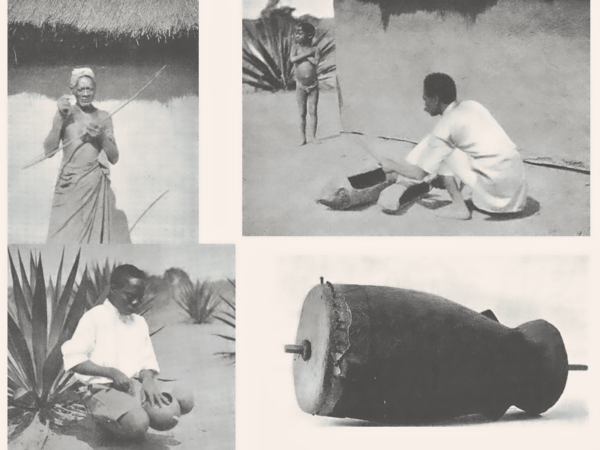
Photo collage 6 ∵ Historical sources on music
Four photos of musical instruments in Doke’s The Lambas of Northern Rhodesia from 1931.1Doke (1931: 363-367).
Contribute to the understanding of the central role of music in cultures in South Central Africa
The descriptions and analyses on this site are to contribute to the understanding of the central role of music in cultures in South Central Africa. The analyses concern the representation, interpretation and evaluation of music and the related dance, text and ritual in Chibale. In most cases, the research is based on Chibale concepts and developed in dialogue with a number of exegetes.
The representation of music
This site aims to contribute to uncovering the underlying principles of South Central African music by presenting ‘sets of coherent statements’ developed in co-operation with local exegetes that demonstrate the relationship between a number of phenomena in and around possession cult music and ritual, by inventorying and comparing the terms used to describe musical features and by comparing the structural and the changeable, performative aspects of music.
The interpretation and the evaluation of music
Publications on song text interpretation and musical evaluation are often concerned with the evaluation and interpretation by specialists only and not by others involved in the music. In this study, we aim to gain a deeper understanding of the evaluation and interpretation of music by the public as well as specialists.
What does the public pay attention to? How is music experienced in Chibale? What feelings are people able to express to have had while listening to music? What variation is there in the interpretation of song texts?
Why and how are song texts important in rituals and other gatherings with music?
How are music, dance and performers assessed in Chibale? What types of evaluation criteria are used and how do they relate to each other?
Photo 220 ∵ Large-scale events for the evaluation of music and dance
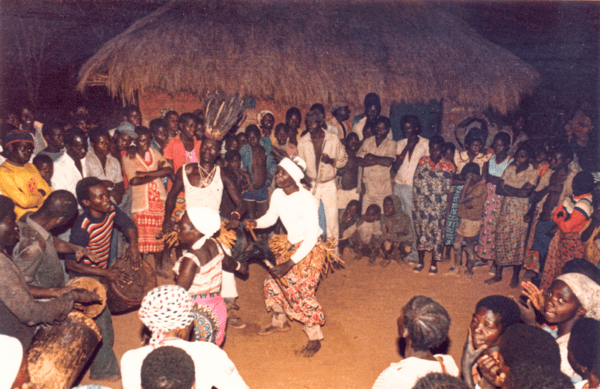
Spirit possessed dancers, drummers and audience/chorus at an Ipupo at banaNjenjema’s in 1985.
Help people in Chibale create media products from a Chibale perspective
In the last period of the research, we co-operated in the Butala project. The aim was to train and coach people in making media products from a Chibale perspective. Moreover, the aim was to conduct viewings around the area and use feedback from viewers to make other products. A third aim was to figure out how the media makers could become self-supporting in the long run.
While the Butala project (2008-2012) was ongoing, the other research was kept current.
Photo 221 ∵ Still from the film The survival of the orphans made by Dauti Kalunga and Prishila Mumba, 2012.
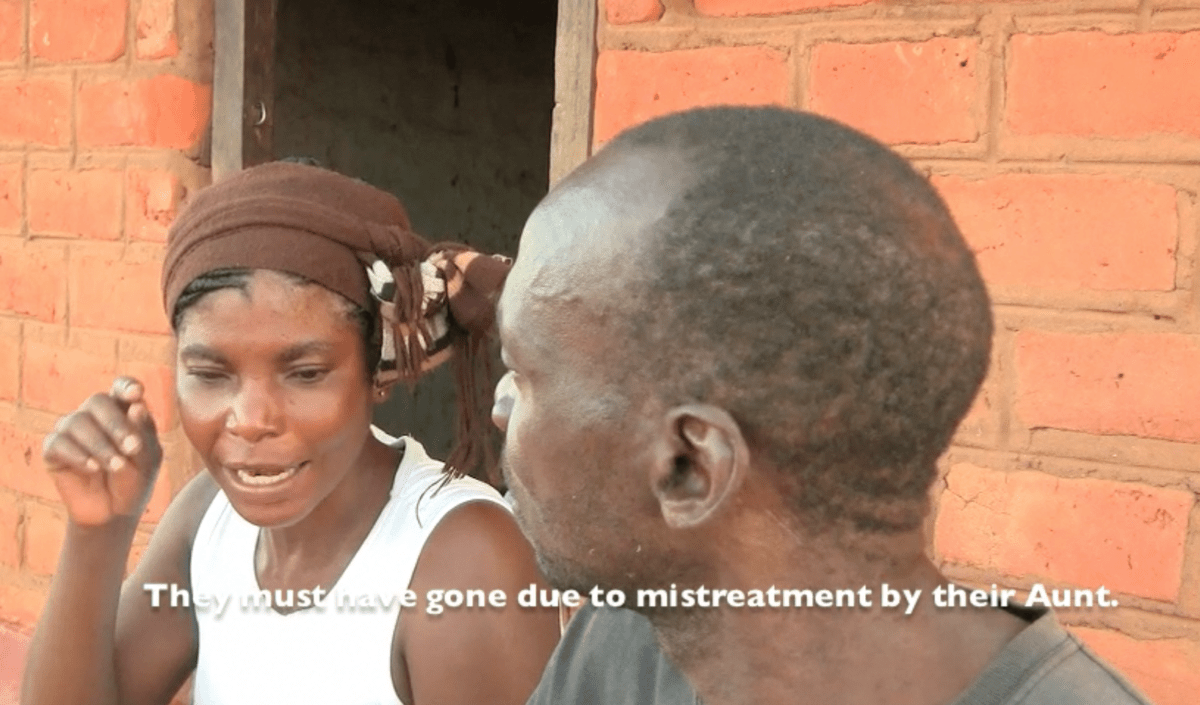
The subtitling was not used for the viewings in Chibale.
Footnotes
- 1Doke (1931: 363-367).