Sheki Mambwe
Sheki Mambwe was born in 1961 in Chipenshi, Chibale. His parents and he himself were Jehovah’s Witnesses, and he never visited Ipupo or similar events. He fell ill in 1977. Chalebaila had just arrived in Chibale and he stayed at Chalebaila’s place until the end of 1978. His relatives did not visit him during this period. At one point, he dreamt he was in a dark room. Then, a light came from above and a person resembling president Kenneth Kaunda appeared in it. He offered a handshake and said: “We are the chiefs; we want you to concentrate on healing. We shall always work through you.” Then he vanished. The following morning, Chalebaila said Kaunda was a vision of the spirits of chiefs possessing people (bamafumu). His possessing spirit’s name was Chiselwa, a Lima chief. He liked to bring the Lenje song Aya mbomba, aya mbomba. Thus, he was called Mbomba. He became Chalebaila’s mwanang’anga which meant he assisted and, when necessary, substituted him. Later, he prepared a Cibombe for his spirits.
Photo 237 ∵ Sheki Mambwe
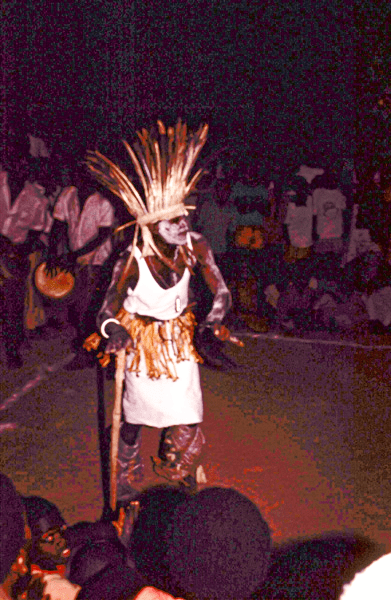 The shing’anga Mbomba dancing at a Cibombe he organised in Luanshya, 1986.
Not long after that, in 1979, he went to Luanshya taking young Munteta with him as his helper (cipyaila). His spirits asked him to go there as it was not good for two shing’anga of such power, namely Chalebaila and himself, to remain in the same area. Furthermore, his family rejected him because of his possession. It was not difficult to start working in Luanshya, as there were many patients there. He became one of the only men in the Traditional Herbalists Association of Luanshya who dealt with possession cases. Luanshya had three compounds. The Association assigned every shing’anga a section of one of these compounds. To be registered with the Association, one had to prove to be a genuine healer. This was done by being giving certain difficult cases to solve and by a conversation with the Provincial Medical Officer.
His practice went very well. He began investing his money in two taxis and a house for renting.