Shemu Mambwe
Shemu Mambwe of the Ngoma (Drum) clan was born in 1947. He lived in Masaninga ward, some 40 kilometres north of Chibale village. His parents and he himself, as a child, were Jehovah’s Witnesses. In 1966, he became ill and visited clinics and hospitals, but to no avail. He remained sickly and, finally, in 1979, dared to visit a shing’anga who gave him medicine.
He turned out to be Ciwila-possessed by the spirit of his mother, banaNgosa, who had not sung or danced when she was alive. The first song came to him in a dream. After that, songs would come in dreams and at Ipupo. All songs had new texts because “every occasion asks for another text”. Other messages he received from the spirits were about coming events and medicine that could help him. This spirit brought one musango the chorus line of which began, at that time, with ‘Ne kansenkele‘: ‘I who do the kansenkele’, a certain dance movement. From this his possession name Kansenkele arose. He started visiting Cililo and Ipupo, and soon people began inviting him, and the area in which he would dance grew. Later, he also danced at shows and certain chiefly occasions, such as the installation of a chief. In the beginning, he danced approximately 20 times a year. This involved travelling to the place, dancing all night, for 10 hours, often being the sole dancer, and then travelling back again. He did not mind, “because that’s how I get treated”.
Kansenkele’s possession looked much like that of the ing’omba of old, even though the ing’omba of older generations often were possessed by the spirits of deceased ing’omba. The illness was not the central focus, but rather the bringing of new song texts, an art for which they were invited across a large area. The emergence of Mwami led to a resurgence of Ciwila possession, not only in Mwami-led cults of affliction but also in a new form of ing’ombaship for the older cults.
His first wife, banaChibuye, also known as Kalilele, was his helper in singing (kampenga) and greatly contributed to his success with her skills. When visiting them two weeks after an Ipupo at which she had also been the helper of the only other Ciwila medium, Bola, dancing there, she managed to reproduce all 92 song texts brought by Kansenkele and Bola.
Photo 239 ∵ Shemu Mambwe
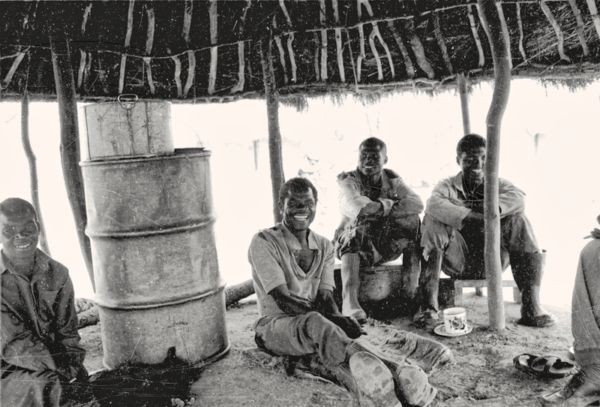 Shemu Mambwe sitting on the ground in the nsaka at his farm, 1981.
In February 1985, after a period of illness, a second spirit took possession of him, Meli, also called banaChibuye, the spirit of his first wife’s deceased sister. This spirit used a new musango in which the name ‘Meli’ or ‘banaChibuye’ was always used. When visiting new areas, Kansenkele brought along a team of four people to help teach the chorus of this new musango.
Photo 240 ∵ Kampenga of Kansenkele
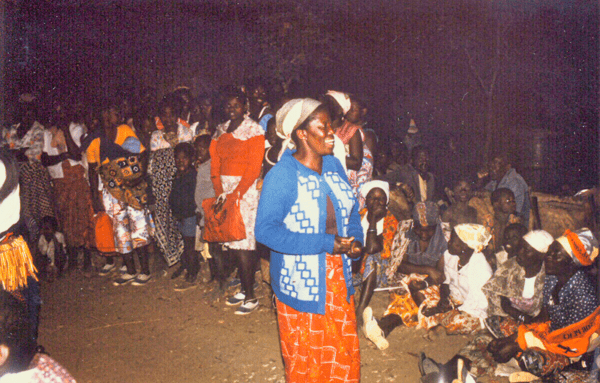 BanaChibuye teaching a song just brought by Kansenkele to the audience/chorus at the Ipupo lya fikankomba, 1985.
Kansenkele’s songs were often copied by other spirit-possessed, especially in more distant areas. “I do not react when they bring my songs, either exactly the same or slightly changed. I count on the people present to know and to have a low opinion of that person.” The copyright was guaranteed by the ludicrousness of the copyist or by the distance the copyist had to the original.
Kansenkele’s first wife died in 1996. He died two years later at the hands of the ex-husband of his third wife.