Songs and dances in Zambia: ciwila
Songs and dances in Zambia: ciwila. The role of Ciwila songs is to mark the occasion and to connect it with other features of Chibale culture.
The dancing is to attract people to listen and learn the song texts through singing while watching. The song texts are composed at the spot. People, also from other areas, regard Ciwila songs, drumming and dancing as typical of the Lala region. As seen elsewhere, the Ciwila melody proceeds by note repetition and steps with only a few jumps. This happens within a melody form that starts high and descends gradually or starts in the middle, ascends and then descends gradually.
Photo 102 ∵ Ciwila dancing
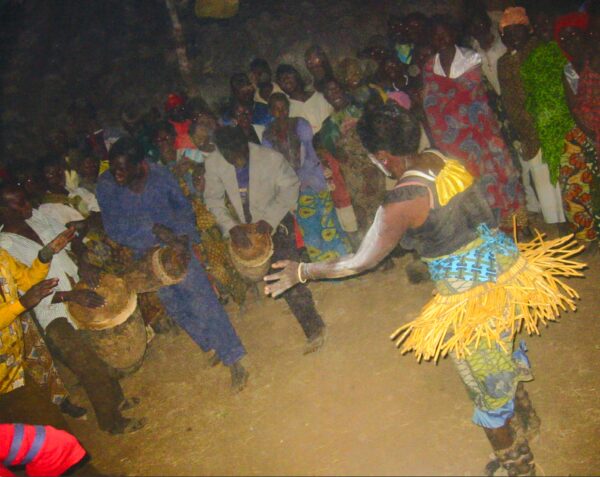
Songs and dances in Zambia: ciwila. In Ciwila dancing, the dancer makes small movements in preparation for the real dancing. When dancing, he stands straight, often with raised arms, the hips pushed forward while the feet point outward slightly. The playing of the nsangwa and the swirling of the masamba, notably keeping it at an angle as high as possible, gets much attention.
Song 47
A Ciwila song sung by Chisenga Machingo (human name: Sitifini Nunda) at an Ipupo in Milombwe, 1981.

Text of Song 47 ∵ Beat the cawayawaya style
Tamumfwa ifyo ntalika baine
Ba Chisenga Machingo balishe cawayawaya owe
Listen how I start, friends
Chisenga Machingo, beat the cawayawaya style owe
Cawayawaya is fast and light drumming often used at the end of a longer ritual or session. Ciwila songs often refer to the quality of the ritual or aim at heating it further. How to heat a ritual, and what role music plays in heating, is discussed in various places on this website.
In the series of articles Fighting with songs a great number of Ciwila songs can be found, both by a medium, in this case the ing’omba Kansenkele, and by members of the cult group of bamukaNdubeni.
A tradition of bringing new song texts to mark the occasion
Songs and dances in Zambia: ciwila. The bringing of new song texts1See the article on the extension of the repertoire for the use of the word ‘new’ in relation to music. for special occasions by mediums has a long history. The earliest record of the Lala region of some length, the visit and demise of David Livingstone in the north of the Lala region in 1873, describes the visit of a dancer who composed a song to mark the occasion of Livingstone’s death.2Livingstone (1874: 316).
Song 48
The oldest transcribed song from the Lala region (1873). No recording.
“[…] early on the 3rd May, a special mourner arrived. He came with the anklets which are worn on these occasions, composed of rows of hollow seed-vessels, fitted with rattling pebbles, and in low monotonous chant sang, whilst he danced, as follows:
Lélo kwa Engérésé, To-day the Englishman is dead,
Muana sisi oa konda: Who has different hair from ours:
Tu kamb’ tamb’ Engérésé Come round to see the Englishman.
His task over, the mourner and his son, who accompanied him in the ceremony, retired with a suitable present of beads.”
The ciLala text is not completely understandable in (contemporary) ciLala. Presumably the text went something like:
Lelo kwa ingeleshi Today [we are] at the place of the Englishman
Mwana mushishi wakonda Who has smooth hair
Tukatambe ngeleshi Come and see the Englishman
Songs and dances in Zambia: ciwila. Songs and dances in Zambia: ciwila.
Footnotes
- 1See the article on the extension of the repertoire for the use of the word ‘new’ in relation to music. ↩︎
- 2Livingstone (1874: 316). ↩︎